Nutrition: Calories and Macros |
 |
| 1 - CALORIE CALCULATION |
|
I don't usually track my nutrition year-round but when "cutting" (or trying to drop weight in general),
it is by far the most effective way to manage your diet. The are many methods out there to calculate your BMR
(Basal Metabolic Rate) which is basically just a minimum amount of calories your body needs to run. Too many factors
go into each method to discuss at length but the system I use is just "guess-timate" at my daily calorie requirements.
The way I confirm my estimates are by tracking my nutrition for a couple weeks and seeing how my weight fluctuates. If your
weight falls, then you are burning more than you ingested (deficit). If you make gains, then you are in a calorie excess.
Cals Per Pound Base calorie per weight calculation. 12-14 kcal/pound - Healthy adult w/ little extra activity 14-16 kcal/pound - Healthy adult w/ moderate activity 16-18 kcal/pound - Healthy adult w/ high activity 18+ kcal/pound - Athlete level Activity Modifier Activity outside of your workouts. x1.2 - Sedentary, no exercise x1.3-1.4 = Lightly Active, light exercise x1.5-1.6 = Moderately Active, regular exercise (3-5 days/week) x1.7-1.8 = Very active, demanding daily routine x1.9-2.2 = Athlete level Weight Direction *** To GAIN weight (bulk): Add 10-20% calories to your total *** To LOSE weight (cut): Subtract 10-20% calories from your total My Maintenance Calculation My weight average is 195lbs. I workout 4-6 days a week (moderate activity). I'm employed as a web developer who sits at a desk all day (sedentary job). BASE CALC: 14-16kcal x 195lbs = 2730-3120 calories MODIFIER CALC: 2730-3120 x 1.2 = 3276-3744 calories Use your judgement to take into account other factors that may modify your calorie estimate (i.e. age, current health, body fat%, etc). As for myself, i'm in my thirties but I still have a somewhat high metabolism so I use a middle ground estimate on my calorie count of 3500cals. Thats about the total amount of calories it takes to maintain my current weight. I generally like just maintaining a healthy, lean weight year-round but the past two winters I did "bulk" on purpose to make some quick size gains. I still ate clean a majority of the time but I didn't allow myself to get hungry at all. I was eating 7-8 meals a day. I calculated my calories for a typical day and it would regularly exceed 4.1k calories. Eating like this during the winter, I put on about 10 lbs of size (peaking at 197lbs). This made sense because I was eating well over my maintenance calorie count. I also cut out cardio during this time. Unfortunately some slop came along with that size too. Since it's summer now and time for the pool, I figured I would try to drop weight as best I can while trying to maintain a little size. I'm at a higher weight and accustomed to eating everything in sight. My first action was to try and break that habit & space out my meals. Moving from about 8 meals a day down to 5-6 meals. I also had to modify the type of nutrition I was consuming. I was eating clean while bulking but I was ingesting a lot of carbs. While dropping weight, I am more carb conscious and tend to go low (or no) carbs from my later meals. I eat a majority of my carbs pre and post workout. And I also aim at a lower overall calorie count of course. My Cutting Calculation I use a median between 10-20% for losing weight to allow myself some wiggle room. 3500 (total) x 15% (cut percent) = 525 calories 3500 - 525 = 2975 calories So for now my target total calories are 3k cals. For my off days (sat/sun) I ingest 90% of my training target (~2.7k). |
| 2 - MACRO CALCULATION |
|
Protein I generally use a standard of 0.8-1.5 grams of protein per pound. To gain muscle, you want to ingest at least 1g/lb or higher. MY PROTEIN CALC (standard based): 195lbs x 0.8-1.5g/lb = 156-292g protein There is also an alternate standard of using a percentage of your total calorie goal to figure out protein. Somewhere between 15-30% of your total calories should be protein. 1g of protein is 4 cals so divide the percentage by four. MY PROTEIN CALC (percentage based): (3200 x 15-30%) / 4 = 120-240g protein I personally aim for about 255g protein per training day (about 1.3g/lb) and try to make sure to eat my current body weight at the very least. Fats I use a standard of 0.4-1.0 grams of fat per pound. While most people try to avoid fat at all costs, your body does need fat to survive. You just don't want an excess of it so I place my ceiling at a gram per pound. Just make sure to not exceed it. MY FAT CALC: 195lbs x 0.4-1.0g/lb = 78-195g fats Carbs This is a really controversial subject for everyone trying to manage their weight. There are many different systems and gimmicks but like with anything you have to ultimately discover what works for you. I use an estimate of 2-3g per pound for carbs. This is for someone that is moderately active. If you are an athlete or someone with an extremely physically taxing job I would go 3+ grams. For people that are not as active you would want to use 2g/lb as a ceiling. MY CARB CALC: 195lbs x 2-3g/lb = 390-585g carbs Since i'm currently cutting, I use 2g/lb as a ceiling and try not to approach 390g of carbs per day. When i'm bulking, it's usually no problem to hit the higher end of this as i'm cramming pasta and rice in my mouth all day. |
|
3 - TRACKING The hardest part of calorie and macro maintenance is tracking your food intake. Some companies (i.e. Weight Watchers, Nutrisystem) make a lot of money by simply making it easier to track your intake or doing it for you. I admit that it sucks. Until you get to your goal weight and fall into a routine of eating that you can upkeep unconsciously, I recommend tracking your nutrition. I personally only do it while cutting and during the summer months just to maintain my abs. While bulking I just eat like crazy. Although I bet that if I tracked my diet while bulking I would likely make cleaner gains instead of having so much slop. I use an iPhone App called: My Macros+ (by Jason Loewy). It's a couple dollars and has a pretty clean interface. The first couple weeks of using any app are a little difficult as you have to enter in the nutritional data for foods that you commonly eat. Once you have most of your regular food items in, it's fairly easy to track each meal. Some apps have large amounts of pre-loaded data for popular foods and restaurants. My goal is to always "eat boring", meaning that I consume a lot of the same foods most of the time during training days. On my off days (weekends) I do open it up a bit and have a cheat meal or two and allow myself to drink alcohol. Whether you use technology or a paper and pen, try to make your best attempt to accurately track your nutrition. Most store or restaurant bought items have nutrition info readily available but home-cooking can be tricky. For home cooked meals I just google search the item and use the nutritional info for the closest recipe. It will give a best guess as to what's in your meal. So it's not an exact science but an educated guess is better than not tracking it at all. |
 |
|
I will post again when I reach my goal in a month or so and also review the workout and supplement changes that occur while cutting.
As with anything, this is just advice and it's up to everyone to find out what works for them. Good luck!
|
| Submitted by Bars |
CheFit.com
Where fitness is a lifestyle. Organized blogs, social media & more!
Where fitness is a lifestyle. Organized blogs, social media & more!
Wednesday, May 23, 2012
Nutrition: Calories and Macros

Monday, May 21, 2012
Workout: Mueller Lake Park Circuit 1
Workout: Mueller Lake Park Circuit 1 |
 |
Equipment Used:
|
|
Tip: This workout is outside, designed for a park with some space & some basic equipment. Scout out parks near you. |
| Tip: At least here in Texas, it's hot as hell outside. Bring water and snack bars to keep your energy up. As always, drink plenty of water and get sufficient rest. |
Circuit #1 |
SUMMARY
|
|
Stretch / Warmup Loosen your muscles (both upper/lower body). Stretch out and hydrate. |
|
1 - Push-Up / Military Press Superset A - Push-Up Click For Video Example Find a soft area to kneel down. Grab your dumbbells and get into the front leaning rest position w/ your hands still wrapped around the dumbbells. Knock out a set of push-ups. Once done, get back onto your knees and move into the Military Press. B -Military Press Click For Video Example While still kneeling after your push-up set, move the dumbbells into position near your head with your arms bent at a 90 degree angle. Perform a set of Military Presses. Afterward, rest 30-60 seconds and then start the superset again with push-ups. Optional: You can perform both exercises without dumbbells if you get tired. |
|
2 - Squats Click For Video Example Standing in front of a park bench (or similar flat surface) , stand w/ feet shoulder-width apart and arms out-stretched. Perform squats. Rest 30-60 seconds between sets. Optional: To increase difficulty, either perform squats with a single weight held near your chest w/ both hands or hold a weight in each hand in the military press position (near your head w/ arms at 45 degrees). |
|
3 - Sit-Ups / Crunches Sit-Up Video Example Crunch Video Example Find a soft area to lie down (or use a mat or park ab equipment). Either peform crunches or sit-ups (may vary based on equipment and/or people to help hold your feet). Rest 30 seconds between sets (abs recover quickly compared to other muscle groups). |
|
4 - Bicep Curls Video Example Grab your dumbbells, stand w/ feet shoulder-width apart and perform bicep curls. Rest 30-60 seconds between sets. |
|
5 - Walking Alternating Lunges Video Example Stand w/ feet shoulder-width apart and at least 30 paces of flat space in front of you. Perform walking lunges. Rest 30-60 seconds between sets. Optional: To increase difficulty, hold a dumbbell in each hand down by your sides as you perform this exercise. Optional: You don't have to, but going down low enough to where your knee touches the ground increases difficulty as well. |
|
6 - Pull-Ups / Chin-Ups Video Example (Assisted) Find a set of pull-up bars (if none available, skip this exercise or perform Delt Rows off a park bench). Perform as many pull/chin-ups as you can un-assisted. If a workout partner or sturdy cooler is available, perform as many assisted pull/chin-ups as possible. Rest 30-60 seconds between sets. Optional: If no pull-up bars are available, perform the following: Delt Rows Video Example Optional: You can use a lower hanging pull-up bar and a sturdy cooler to perform assisted pull/chin-ups. Optional: If you have a friend available, you can bend your knees and have a friend assist you by pulling up on your knees. |
|
7 - Tricep Dips Video Example Start seating on a park bench (or similar raised flat surface) with your feet flat on the floor and your legs bent out slightly more than 90 degrees. With your palms flat on the bench and your fingers facing the same direction as your body, push your butt out in the air so that you are being supported by your arms. Perform dips. Rest 30-60 seconds between sets. |
|
8 - Incline Wind Sprints Video Example Find a steep hill w/out too much debris and uniform surface. Allow enough flat space at the bottom of the incline to slow down. Sprint quickly up the hill and jog back down. Repeat several times and then rest. Optional: If no suitable hills are available, you can run a step of stairs for an incline workout. |
|
9 - Agility Slalom Run Video Example Find a set of trees (or other obstacles/landmarks) that are staggered and spaced on flat ground (pictured at the top of the page). Run around each obstacle, alternating left to right. After the last obstacle, clear to the side of all obstacles and sprint straight back to the start. Rest 30 seconds (or until you catch your breath). Optional: You can setup a set of cones, spray paint waypoints on the ground or use other means to create the obstacles course to navigate around. |
|
10 - Optional Run If you're still up for it, either walk or jog a short 1/4 to 1/2 mile course around the park. Walk the entire route to cool down or if you're not tired yet, perform alternating sprints and jogs every 1/8 mile. Walk it out an extra 1/8 mile at the end to cool down after. |
| Hydrate, Rest and Recover. Good luck!!! |
|
DIRECTIONS The closest intersection is at the edge of the park. Map to the following intersection: Simond Ave & Mattie St, Austin TX 78723 |
FROM NORTH AUSTIN
|
FROM SOUTH AUSTIN
|
Tuesday, May 1, 2012
Nutrition: Mango Protein Shake
Nutrition: Mango Protein Shake |
 |
|
Mango Protein Shake Video |
Recipe
|
Directions
|
ReviewThis shake is fast to prepare and adds a healthy boost to your day. The greek yogurt provides extra protein and less carbs compared to regular yogurt. It also has a probiotic element for your digestive system. If adding in the optional greens or flax/chia seeds, you gain more vitamins, omega-3s and anti-oxidants. The consistency is water-like and goes down smooth, even with greens added. Tips: *** You can pre-cut a large amount of fruit or keep a large bag of frozen fruit to make preparation time decrease for future shakes. *** If using greens, be sure to pull the leaf off the stem if adding larger, thicker greens like mustard greens or kale. Generally spinach can be used as is. *** If the shake winds up being too sweet, decrease the amount of juice used and replace with unsweetened almond or soy milk. |
| Possible Substitutions |
 |
| Finished Product (w/ greens added) |
 |
Monday, April 30, 2012
Workout: Spring Full Body Circuit 2
Workout: Spring Full Body Circuit 2 |
 |
Equipment Needed:
|
| Tip: When starting out, perform all exercises with light weight (or no weight on the leg exercises) until you learn correct form and become familiar with the routine. This also allows you to figure out your recovery time as light weight may be enough to challenge you initially. |
| Tip: This workout hits abs, shoulders, chest, biceps, triceps, glutes, hamstrings and calves. It is really a total body workout so allow at least a days rest in between circuits when starting out. Drink plenty of water and get sufficient rest. |
| Tip: You can alternate this workout with the previously posted Circuit #1 |
Circuit #2 |
SUMMARY
|
|
Stretch / Warmup Stretch your upper body 1- Place your hands on your hips and legs shoulder-width apart. Roll your neck in circles slowly, reversing direction ocassionally. 2 - Look forward and extend your arms out parallel to the ground. Start making small forward circles with your arms. Slowly increase the size of the circles over time until you are making large circles. Reverse direction at this point. 3 - Keep your arms out, look forward and twist your torso back and forth slowly while keeping your arms locked out. 4 - Place your hands back on your hips and roll your hips in a circular fashion clockwise. After 5-10 revolutions, reverse direction. Stretch your lower body 1 - Legs shoulder-width apart, clasp your hands together and reach toward the sky. Make sure to breathe. After a few seconds slowly bend over and reach toward the ground. Try to keep your head above your heart (unless you're super flexible). Repeat the sky/ground reaches for a few repitions. 2 - With your feet and legs together and your hands at your sides, take a half step forward with your left foot so that your left knee is bent. Take your right foot and step back a whole step so your right leg is straight. Stretch and then reverse feet. 3 - Sit on the ground and attempt to place the bottoms of your feet together. Pull your feet toward your groin area slowly. Warmup 1 - Perform 10 Jumping Jacks. 2 - Get on the ground and do 5 push-ups on your knees. 3 - Stand back up and do 10 high knees. 4 - Repeat warmup exercises until you feel loose and have a slightly elevated heartrate. |
|
Abs A - Flat Bench Reverse Crunch Video Example Sit near the end of the flat bench. Lay flat back onto the bench. Reach behind your head and hold the sides of the flat bench. Place your legs together and extend them out in front of the end of the bench. They should be parallel to the ground with your butt firmly on the bench still. Perform reps by raising your knees and pulling them in toward your chest & elbows. Release by returning your legs back to the starting position. Optional: To make it tougher, you can place a weighted medicine ball in between your kness and perform the exercise. Perform at least 10 reps (or as many as you can do if less) and then rest 30 seconds. Repeat at least three times. B - Standing Knee Raises Video Example Stand tall with your feet shoulder width apart. Grab a light weight and hold it with both hands and your arms extended outward about chest high. Perform reps by raising one knee high enough to meet your outstretched arms holding the weight. Relax by returning your feet back to the starting position. Alternate knees each rep. Perform at least 10 reps per knee (or as many as you can do if less) and then rest 30 seconds. Repeat at least three times. |
|
1 - Knee Push-Ups Kneeling on the ground, lean forward and place both hands on the ground slightly larger than shoulder width apart. Keep your back straight, knees on the ground and you can optionally cross your lower legs and feet. Perform kneeling push-ups. Rest 20-30 seconds between sets. Decrease rest to increase intensity. Video Example Set#1: 10 reps (or until failure if less) Set#2: Repeat Set #1 Set#3: 5-10 reps (or until failure if you can do 10+) |
|
2 - Reverse Lunges With your feet together and the weights down by your sides, perform reverse lunges (stepping backwards). Rest 20-30 seconds between sets. Decrease rest to increase intensity. Video Example Set#1: 5 reps on each leg w/ light weight in hand Set#2: Repeat Set #1 but w/ heavy weight in hand Set#3: 10 reps on each leg w/ light weight in hand |
|
3 - Dumbbell Front Raise With your feet together and the weights in hand, down in front of your body, perform front raises. The standard grip is to handle the dumbbell with your palms facing your body and parallel to the floor once raised (as in video example). You can optionally have your palms facing your thighs (hands by your sides) and perpendicular to the floor once raised. Rest 20-30 seconds between sets. Decrease rest to increase intensity. Video Example Set#1: 10-15 reps w/ light weight Set#2: 4-8 reps w/ heavy weight Set#3: Repeat Set #2 Set#4: 10+ reps with light weight (or to failure if less, or skip if wiped from previous set) |
|
4 - Bench Step Ups Standing in front of the flat bench (or chair), stand w/ feet a little closer than shoulder-wodth apart. Have your arms at your sides w/ the appropriate weight in each hand. Take one foot and place it onto the bench. Push off that same foot and raise the rest of your body up so you can step onto the bench with your other foot. To relax, take the original foot you stepped onto the bench with and step down onto the ground. Once planted, return your other foot to the ground. Perform setp-ups. Rest 20-30 seconds between sets. Decrease rest to increase intensity. Video Example Set#1: 5 reps each leg w/ no weight in hand Set#2: Repeat Set #1 but w/ light weight in hand Set#3: 10 reps each leg w/ heavy weight in hand |
|
5 - Tricep Dips Start seating on the bench with your feet flat on the floor and your legs bent out slightly more than 90 degrees. With your palms flat on the bench and your fingers facing the same direction as your body, push your butt out in the air so that you are being supported by your arms. Perform dips. Rest 20-30 seconds between sets. Decrease rest to increase intensity. Video Example Set#1: 5 reps Set#2: 10 reps Set#3: 5-10 reps (or until failure if you can do 10+) |
|
6 - Medicine Ball Squat Press Stand with your feet shoulder-width apart and hold a weighted medicine ball with both hands and a nuetral grip. If you lack a medicine ball, you can use a heavier dumbbell or other equally heavy object. Perform Squat Presses. Rest 20-30 seconds between sets. Decrease rest to increase intensity. Video Example Set#1: 5 reps Set#2: 10 reps Set#3: 10 reps or until failure if 10+ (if arms tired, perform without any weight in hand) |
|
7 - Medicine Ball Curls Stand with your feet shoulder-width apart and hold a weighted medicine ball with both hands and a nuetral grip. If you lack a medicine ball, you can use a heavier dumbbell or other equally heavy object. Perform curls. Rest 20-30 seconds between sets. Decrease rest to increase intensity. Video Example Set#1: 10-15 reps Set#2: Repeat Set #2 Set#3: Repeat Set #2 (use heavier ball/object if possible) Set#4: 10-15+ reps with lighter ball/object |
|
8 - Single Leg Stand Up Stand in front of a chair or flat bench w/ your legs somewhat close together. Hold your arms out for balance and slightly lift one foot off the floor. Perform a squat using only one leg and take a seat onto the chair/bench behind you. You may extend your raised foot outward for balance if needed as well. Rest a second, and then return to standing using only that same leg to propel you upward. Perform single leg stand ups. Rest 20-30 seconds between sets. Decrease rest to increase intensity. Note: The example video is performing the toughest version of this exercise by squatting to the ground almost. Based on your individual flexibility and strength, you may want to alter this exercise. Start out squatting onto something relatively high off the ground and easy to accomplish (ex. tall chair or couch). Gradually lower the height of your target squat as your prowess increases. Video Example Set#1: 4 reps per leg Set#2: 6 reps per leg Set#3: Either repeat Set #2 or only do 4 reps per leg but squat to a lower height |
| Good luck!!! |
Monday, April 16, 2012
Workout: Spring Full Body Circuit #1
Workout: Spring Full Body Circuit 1 |
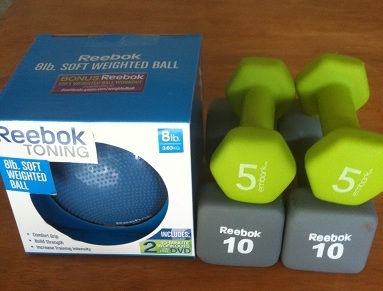 |
Equipment Needed:
|
| Tip: When starting out, perform all exercises with light weight (or no weight on the leg exercises) until you learn correct form and become familiar with the routine. This also allows you to figure out your recovery time as light weight may be enough to challenge you initially. |
| Tip: This workout hits abs, shoulders, chest, biceps, triceps, glutes, hamstrings and calves. It is really a total body workout so allow at least a days rest in between circuits when starting out. Drink plenty of water and get sufficient rest. |
Circuit #1 |
SUMMARY
|
|
Stretch / Warmup Stretch your upper body 1- Place your hands on your hips and legs shoulder-width apart. Roll your neck in circles slowly, reversing direction ocassionally. 2 - Look forward and extend your arms out parallel to the ground. Start making small forward circles with your arms. Slowly increase the size of the circles over time until you are making large circles. Reverse direction at this point. 3 - Keep your arms out, look forward and twist your torso back and forth slowly while keeping your arms locked out. 4 - Place your hands back on your hips and roll your hips in a circular fashion clockwise. After 5-10 revolutions, reverse direction. Stretch your lower body 1 - Legs shoulder-width apart, clasp your hands together and reach toward the sky. Make sure to breathe. After a few seconds slowly bend over and reach toward the ground. Try to keep your head above your heart (unless you're super flexible). Repeat the sky/ground reaches for a few repitions. 2 - With your feet and legs together and your hands at your sides, take a half step forward with your left foot so that your left knee is bent. Take your right foot and step back a whole step so your right leg is straight. Stretch and then reverse feet. 3 - Sit on the ground and attempt to place the bottoms of your feet together. Pull your feet toward your groin area slowly. Warmup 1 - Perform 10 Jumping Jacks. 2 - Get on the ground and do 5 push-ups on your knees. 3 - Stand back up and do 10 high knees. 4 - Repeat warmup exercises until you feel loose and have a slightly elevated heartrate. |
|
Abs Reverse Ab Crunch Video Example Sit near the end of the flat bench. Lean back slightly and hold the sides of the flat bench. Place your legs together and extend them out in front of the end of the bench. Perform reps by bending your knees and pulling them in toward your chest while leaning forward. Release by leaning back into starting position and extending your legs back out. Perform at least 10 reps (or as many as you can do if less) and then rest 30 seconds. Repeat at least three times. |
|
1 - Military Press Seated on the flat bench (or chair) perform 4 sets of Military Presses. Rest 20-30 seconds between sets. Decrease rest to increase intensity. Video Example Set#1: 10-15 reps w/ light weight Set#2: Repeat Set #1 Set#3: 6-10 reps w/ heavy weight Set#4: 2-8 reps w/ heavy weight and then 10+ reps with light weight |
|
2 - Stationary Lunges Standing in front of the flat bench (or chair), place the top of one foot on the bench w/ your heel facing the sky. Dumbells are in hand. Perform stationary lunges. Rest 20-30 seconds between sets. Decrease rest to increase intensity. Video Example Set#1: 5 reps on each leg w/ light weight in hand Set#2: Repeat Set #1 but w/ heavy weight in hand Set#3: 10 reps on each leg w/ light weight in hand |
|
3 - Lying Dumbbell Chest Press Lying on the flat bench (or on the floor) perform 4 sets of Dumbbell Chest Presses. Rest 20-30 seconds between sets. Decrease rest to increase intensity. Video Example Set#1: 10-15 reps w/ light weight Set#2: 6-10 reps w/ heavy weight Set#3: Repeat Set #2 Set#4: 2-8 reps w/ heavy weight and then 10+ reps with light weight |
|
4 - Squats Standing in front of the flat bench (or chair), stand w/ feet shoulder-width apart and have your arms bent with your weights up near your ears. Perform squats. Rest 20-30 seconds between sets. Decrease rest to increase intensity. Video Example Set#1: 5 reps w/ no weight in hand) Set#2: Repeat Set #1 but w/ light weight in hand Set#3: 10 reps w/ light weight in hand |
|
5 - Standing Hammer Curls Standing up with your feet should-width apart and your weights down by your sides, perform hammer curls. Rest 20-30 seconds between sets. Decrease rest to increase intensity. Video Example Set#1: 10-15 reps w/ light weight Set#2: 6-10 reps w/ heavy weight Set#3: Repeat Set #2 Set#4: 2-8 reps w/ heavy weight and then 10+ reps with light weight |
|
6 - Calf Raises Standing on flat ground w/ your feet a few inches apart and your weights by your sides. Perform calf raises. (This is better performed standing on the step of a staircase or elevated slab in the garage. Somewhere you can have the heels of your feet hanging off the elevated platform into free air) Rest 20-30 seconds between sets. Decrease rest to increase intensity. Video Example Set#1: 10-15 reps w/ light weight Set#2: Repeat Set #1 w/ heavy weight in hand Set#3: Repeat Set #2 |
|
7 - Tricep Kickback With your right knee on the bench, bend over and place your right hand on the bench as well. Your left leg should be planted on the ground to the left of the bench. A weight should be in your left hand w/ your elbowtucked near your ribcage. Perform kickbacks. Rest 20-30 seconds between sets. Decrease rest to increase intensity. Video Example Set#1: 10-15 reps w/ light weight Set#2: 6-10 reps w/ heavy weight Set#3: Repeat Set #2 Set#4: 2-8 reps w/ heavy weight and then 10+ reps with light weight |
|
8 - Standing Lunges With your feet together and the weights down by your sides, perform lunges. Rest 20-30 seconds between sets. Decrease rest to increase intensity. Video Example Set#1: 8 reps per leg w/ light weight Set#2: Repeat Set #1 w/ heavy weight in hand Set#3: 4 reps per leg w/ heavy weight and then 8 reps w/ light weight |
| Enjoy!!! |
Monday, April 2, 2012
Nutrition: Basic Supplements
Nutrition: Basic Supplements |
 |
|
The best way to nourish your body is through a wide variety of healthy foods. Nutrients from food are more natural, more easily digestible and best absorbing. That being said, not everyone has the time or ability to prepare and eat a complete diet. Whether you're extremely active athletically or just worried about your general health and well-being, vitamins and supplements are beneficial for filling in the gaps within your diet. Your body is a temple but it's only as strong as the building blocks used to construct it. Fill in the cracks of your foundation with supplement support. Supplements come in a wide variety of strengths and types. They don't necessarily have to be expensive or hard to find either. Below we will go over some basic and easy to find supplements that will benefit both casual and hardcore fitness fans. I visited my local grocery store to comparison shop against my usual online source of supplements (Bodybuilding.com). While the online store was generally cheaper per bottle of supplement, the shipping charge equalizes the cost in most cases. I suggest to choose large quantities and bundle your supplements into one order to reap the benefit of savings from purchasing online. Otherwise the local grocer had comparable prices and the convenience of immediate consumption. |
 |
|
MULTIVITAMIN A good, all-around supplement as it covers a wide range of basic nutrients essential for peak performance. This is beneficial because those that are more active than normal may require a greater amount of base vitamins and minerals. Also as we age, our bodies ability to naturally produce certain nutrients slows so a good supplement can help us recover and repair quicker. Cost-wise, multivitamins can range from cheap to very expensive. For the average person, any off the shelf multi will work. They are relatively cheap at your local grocer or pharmacist. If you are a serious runner or lift weights regularly, you may want to try out a vitamin stack that is more tailored toward your needs. I personally use Universal Animal Pak but I lift weights several days a week. There are also multi's that are gender specific to treat the individual needs of women as opposed to men. For you vegetarians out there, a multi like the one pictured here lacks the animal-based gelatin caps. On average a multivitamin may contain around 60-90 capsules for about $10-15 locally. A typical dosage is only 1 or 2 per day so they tend to last about 1 to 2 months depending on container size. Not a terribly expensive investment in your health. My Universal vitamin pack comes in a container w/ 44 servings for about $30. So the special vitamins are a tad bit more expensive but only recommended for those with more extreme regimens. |
 |
 |
|
GLUCOSAMINE / CHONDROTIN The fluid in our joints and body cushioning contains Glucosamine. Often times you will see a glucosamine supplements paired with Chondroitin because it retains water & encourages nutrient flow within our joints. Whether it's lifting weights, zumba or running, joints are integral pieces of each exercise. Adding joint support supplements helps maintain healthy cartilage tissue, lowers your risk of stress fracture and lubricates joints. Generally a supplement with both combined is more pricey than just glucosamine alone. Chondroitin has anti-inflammatory properties so those with joint issues already should definitely include this. I personally just take glucosamine alone since there are other supplements I take that have joint support components. About 60-90 capsules of a Glucosamine/Chondroitin combo will run around $15 a container locally but may last less than your multi as the recommended dosage is often 2-3 times a day. Larger containers give you more bang for your buck and generally fun cheaper when bought online. |
|
 |
|
 |
 |
|
FLAX, FISH, AND OMEGA-3's Not all fat is bad! In fact certain types of fat derivatives are good for your body and required to keep it running smoothly. An example of a beneficial fatty acid are omega-3s. Omega-3 fatty acids are generally found in marine and plant oils. Our body does not produce omega-3s naturally so we must ingest it via our diet. Unless your diet is super high in cold water fish, you are probably deficient in omega-3s. Fortunately this is where supplements come in handy. Fish contain a natural source of omega-3 essential fatty acids. Thus fish oil supplements help raise your omega-3 counts. If you're not into seafood, you can alternately take Flaxseed Oil supplements. Flaxseed has an additional benefit of boosting your fiber intake (feel less hungry and maintain regularity). There are several combination vitamins which contain a range of fatty acids as well (omega 3,6 and 9). Supplements are, as the name implies, designed to supplement your diet. There are several natural sources from which you can consume essential fatty acids. In addition to certain fish, most dark, leafy greens contain omega-3s. Example: kale, spinach, collard/mustard greens, etc (See Kale Shake recipe). Grapeseed oil and almonds are good sources of omega-6s. Almonds also overlap into omega-9s along with avocadoes. The complete list of omega sources is too large to list here. The omega products tend to be slightly cheaper than the other supplements named above. Generally 100 capsules is going to range from $10-12 locally. The recommended dosage is the standard 2-3 times per day in which for this supplement group, I usually follow. At least with Fish Oil, I take 2-3 per day. Since the capsules per container size is larger with this group, they will last just as long as your multi. |
|
|
CONCLUSION |
|
The most basic "stack" (group of supplements) for aerobic exercise or weightlifting that I would recommend is to use at least a multivitamin along with protein powder. Protein helps your muscles repair, which burns calories as they repair and works as an excellent meal replacement or snack. You can find it in all flavors and configurations based on if you're looking to gain mass, tone up or cut carbs. In a later post we will go more in-depth into protein. I would add glucosamine and fish oil (or one other omega supplement) to the stack next. This covers your joints and cardiovascular health. When getting into heavier or more serious exercise we are moving towards adding creatine, glutamine, amino acids and other supplements. Again that will be for a later blog post. Until then, if you haven't looked into supplementing your diet, you should! Read up, educate yourself and get out there and try to figure out what works for you and your dietary needs. Good luck... |
| Submitted by Bars |
Saturday, March 10, 2012
At Home Beach Body Workout
Ladies: At Home Beach Body Workout |
 |
|
Summer is soon upon us so that means it's time to break out the swimsuits. Although fitness is a lifestyle, it's never too late to start preparing for pool season. A
common misconception is that you can target certain areas of your body to burn fat from. This unfortunately isn't true but what you can do is tone certain areas so
when you shed that body fat, your muscles will come shining through. Women tend to want to focus specifically on cardio but they really should incorporate weights.
Women have different types of hormones compared to men so you will not instantly become "manly" or "buff" by lifting weights. Cardio is great but it burns calories
primarily while you are performing the exercise. As your body gets used to a cardio exercise, you have to perform that exercise longer to recieve the same initial
effect. Thus you're on the treadmill forever to try and burn the same amount of calories as you once did. It's also extremely boring! |
|
Weight training tears muscle. As the muscle rebuilds, it's requiring energy and burning calories throughout the day (and night). With weights, you simply use heavier
weights once your body gets to used to your current routine. So you never have to increase the amount of time needed to exercise like you do with cardio. So try to
mix in weights or any sort of high intensity training (HIT) with your cardio ladies. You'll shed fat and gain tone all at once. A beneficial tendency for women is to
focus on leg routines. This is actually beneficial because the leg muscles are among the largest in the body. By tearing that muscle you are forcing the body to
repair large quantities of tissue and thus burning large amounts of calories. There are "bonus" leg exercises included below to help shape your butt and
thighs. |
|
Below are some exercises and a sample routine that gives you a fast, total body workout. It hits the upper body, lower body and abs. Start out slow and learn the form
for each exercise. Once you have the routine down, you can increase the pace of the exercises and shorten your rest period between repetitions. This should also allow
you to build up a good sweat and get your heart pumping like a cardio or HIT session. I also outline a "superset" routine which combines two exercises into one merged
set of movements. All the exercises can be performed at home with or without a set of dumbbells. There is one exercise that uses a resistance band but it can be done
without it as well. |
Beach Body Workout Example |
| Clear out some space in an area with a soft surface as we will be lying on the ground (or use a yoga mat in the garage). If you have a set of dumbbells or kettlebells, have them handy. You could also use a chair (i.e. folding chair) and a resistance band if you have them. If you lack these items, the routine will still work. All exercises are numbered and there are video examples of the exercise at the bottom of the page. Please review these videos before attempting the exercise if you're not familiar with them. |
INTENSITY TIP: You could also alternately perform the exercises in a "circuit". For example: Lie flat on the floor and knock out 10 reps of alternating ab crunches first. Stand up, check your form and then perform 10 chair squats. Get on your knees, then knock out 10 push-ups. While still on the floor, go into a plank position and hold for 30 seconds. Stand up, grab a couple dumbbells and start 10 reverse lunges. After the last lunge, place your feet shoulder width apart and perform 15 military presses. Take a quick break, drink some water and then hit it again! Each "circuit" will represet a set. You can increase sets, increase weights used during the set or time yourself and try to finish the circuit quicker to increase the degree of difficulty. INTENSITY TIP: You can insert the bonus exercises into your circuit. You can start the circuit with side lunges and then move onto the ab crunches. After you finish the plank portion of the circuit, while still on the floor, add 10 Donkey Kicks per leg. |
Superset Example |
| Use all the tips from the previous example but here make sure you're familiar with the exercises and have good form. This is similar to the "circuit" style workout outlined in the intesity tip above. |
|
Exercises(w/ links to YouTube video examples) |
Main Routine |
|
1 - Alternating Ab Crunch Click For Video Example 2 - Front Plank Click For Video Example 3 - Chair Squats Click For Video Example 4 - Reverse Lunges Click For Video Example 5 - Push-Up (knees) Click For Video Example 6 - Military Press Click For Video Example |
Bonus - Leg Exercises |
|
7 - Donkey Kicks (Glute Raises) Click For Video Example 8 - Side Lunges Click For Video Example 9 - Resistance Band Side Step (Can do without band) Click For Video Example |
For more exercises, please visit an earlier post: Home Dumbbell Workout Exercises
See you in Padre!!!

Subscribe to:
Posts (Atom)